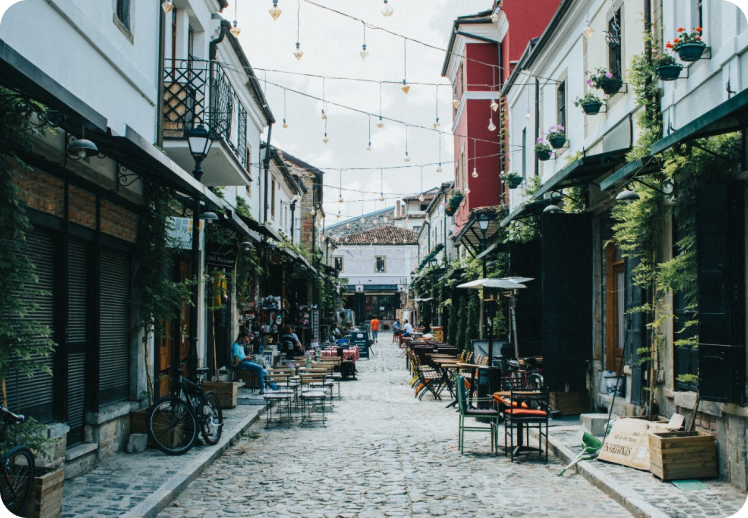
Albania, country in southern Europe, located in the western part of the Balkan Peninsula on the Strait of Otranto, the southern entrance to the Adriatic Sea. The capital city is Tirana. The official language is Albanian.
POPULATION
2,771 million inhabitants
CURRENCY
Albanian Lekë (ALL)
GDP
$27,18 billion
MINIMUM MONTHLY WAGE:
50.000 ALL
(610 USD/515EUR)
TIME ZONE
UTC +1
Albania is one of the least economically developed countries in Europe – half of the population makes a living from the activities of the primary economic sector, and a fifth of citizens have emigrated abroad.
After the transition from the communist political system, Albania was the poorest country in Europe. This was fueled by a strictly state-run
economy under the Communists; complete collectivization was carried out, all private companies were banned, and according to the
constitution, foreign companies were not allowed to invest in the state economy. Foreign economic aid was also rejected.
Employment contract
✓ Employment contract
Employment contracts may be agreed orally or in writing. In the event that the employment contract is agreed orally, the employer is obliged to produce a written contract within 30 (thirty) days from the date of the oral agreement.
✓ Part-time employment agreement
The employee agrees to work on an hourly basis, either half or complete working day for the normal duration of a week or month, which is shorter than that of full-time employees working under the same conditions.
✓ Home-based work agreement
The employee is obliged to carry out his job at his home or any other location chosen by him/ her based on the alternatives offered by the employer.
✓ Commercial agent agreement
✓ Agreement for acquiring a specific profession
Concluded between the teaching master and the person who is studying to acquire a specific profession.
✓ Service agreement
It is another type of engagement frequently used in practice in Albania. However, this type of agreement can only be entered into with physical person(s) registered for commercial purposes. The service agreement is a sui generis agreement, and such agreement is regulated by the Albanian Civil Code and not by the Labor Code.
The Albanian work week is 40 hours, with a standard workday of 8 hours. The daily break is at least 11 consecutive hours within the day or within two consecutive days in case of need. The weekly break is at least 36 hours, within which 24 hours are without interruption.
All work above the standard 40 hours a week is to be paid at a minimum rate of 25% more than the standard pay rate. If the work is done during a weekend or public holiday, the minimum rate is 50% more than the standard pay rate. Overtime can be compensated with time off from work rather than payments on the same basis.
Collective agreements and contracts regulate overtime, however, the labor code states that no employee can work more than 200 hours overtime in any one year. As per the Albanian Labor Code, the employer cannot request an employee to work overtime if they have already worked 48 hours in any one week, unless in exceptional circumstances.
The restrictions state that these special circumstances cannot be longer than four months and the employee’s average working timecannot exceed 48 hours.
There are further restrictions for overtime e.g. night workers and the associated type of work to be performed and who is going to undertake the overtime, e.g. pregnant employees and those under 18 years of age.
The regulations regarding paid leave in Albania are set in the Albanian Labor Code, which states that an employee who has worked
a full year is entitled to 28 calendar days (20 working days) of paid leave which the employee must take during the working year or
within the first three months of the following year. Any employee with less than one year’s service will receive pro-rata leave days.
All leave requests must be provided to the employee at least 30 days before the leave start date.
Additional vacation may be agreed to in the employment contract or collective agreement.
Albania has 14 public holidays.
01-Jan | New Year’s Day* |
02-Jan | New Year’s Day* |
14-Mar | Summer Day |
20-Mar | Eid al-Fitr (End of Ramadan)** |
22-Mar | Nevruz Day |
05-Apr | Catholic Easter* |
15-Apr | Orthodox Easter* |
01-May | International Worker’s Day* |
27-May | Eid al-Fitr (End of Ramadan)** |
05-Sep | Saint Teresa Sanctification Day |
22-Nov | Flag and Independence Day* |
29-Nov | Liberation Day* |
08-Dec | National Youth Day |
25-Dec | Christmas Day* |
observed on the following working day or days (Monday and Tuesday).
Albania Public Holidays 2023
BENEFITS
The state provides public healthcare. However, it is common for employers to offer supplementary private healthcare. bonuses in terms of financial rewards
An employee can claim sick leave for the entire time of their illness until their doctor confirms that the employee is
able to return. For the first 14 days of sick leave, the employer is obligated to pay 80% of the employee’s salary. From
the 15th day onward, social insurance compensates the employee for 70% of their average salary for the past 6 months.
Expectant mothers (who have worked for 12 consecutive months) are entitled to up to a year of paid maternity leave, with a minimum of 35 days paid before birth and 63 days after delivery. After 63 days, the employee can remain on leave or return to work. Women who are expecting more than one child are entitled to 390 days of maternity leave.
The first six months of maternity pay is calculated at 80% of the employee’s average monthly salary from the previous year.
The following six months’ maternity pay is reduced to 50%, as detailed in Article 104 of the Labor Code.
Parental Leave
Parental leave in Albania is 12 days of paid leave to tend to a child. Employees with children under three years old are entitled to an additional three days and can request additional unpaid leave for up to thirty days per year should it be required to care for the child.
✓ Social security: it is collected from the monthly salary, contributed by employer (16,70%) and employee (11,20%). The contribution cover:
Temporary or permanent disability,
Work accident which ends with death of the employee,
Occupational disease.
✓ Mandatory healthcare: the healthcare system is of poor quality and is mainly used by people who cannot afford the higher cost of the private system.
✓ Personal accident insurance: this benefit is mandatory in the mining work sector by following criteria: the scope of coverage is regulated by law; employers cover the cost of policies, and the mandatory limit is 48.000€.
✓ Retirement: pension funds are not compulsory, so people strive to conclude long-term life insurance with investment that combines both protection and savings.
✓ Healthcare: Albania is driven by private healthcare provided by private companies, used by people with higher incomes. The scope of coverage is divided into 3 levels: standard limit (up to 50.000€), silver (100.000€-200.000€) and gold (200.000€-300.000€). This includes out and in-patient coverage:
Visits to specialists
Lab tests
Medication/treatment during the hospital stay
Surgery and consumables and accessories used in the surgery room
Road ambulance and emergency room
Pregnancy package (monitoring of pregnancy)
Dental and vision coverage / poor cover up to 300 EUR.
✓ Travel health insurance: this represents medical expenses occurred during trips abroad.
All persons meeting the following conditions are eligible to obtain the unemployment benefit:
✓ they have contributed to the social security system for a period of at least 12 months.
✓ they have certificates from the labor offices attesting that they are unemployed,
✓ they are willing and available for training or retraining and they do not receive any other benefit under this law,
except for partial invalidity payments.
✓ Performance-based bonuses: usually provided after work evaluation, annually.
✓ Voluntary pension funds: to take over the payment on employee’s behalf.
All foreign visitors need a visa to enter Albania and a residence permit to live there.
Foreigners wishing to work in Albania, depending on their citizenship and the nature of work intended, may require a different type of employment permit,
✓ work registration certificate (for listed activities lasting no more than 60 or 90 days),
✓ employment declarations,
✓ work permit (planning to work and stay in Albania for more than 90 days in 180 days.)
The work permit is submitted to the Directory of Migration of the National Employment Service and is generally issued within ten days of the submission by the applicant. There are four main Albanian work permit categories:
✓ Type C: Permits for special occasions, and
✓ Type D: Permanent work permits for eligible foreigners.
The current residence permits for foreign nationals in Albania, last from 3 months to 5 years, and can even be permanent.
The special work permit is only given to foreign nationals after it has been approved by the National Agency of Employment and Qualifications, where the employee or the employer can submit their application. In addition, for citizens coming from the EU or the United States of America, the permit is issued automatically for a 5-year period.
Notice must be given in writing.
✓ When the employer aims to terminate the contract of employment, he must offer to employee
the opportunity to express himself/herself. The employee must be informed in writing at least 72 hours before the meeting, and during the meeting, the employer shall present to the employee the reasons concerning the decision. The outcome of the meeting needs to be submitted to the employee within a period of 48 hours or up to one week after the meeting. The written notification can be sent by e-mail.
✓ In cases where employee is a representative of the trade union, the consent of this organization is needed.
Notice periods within Albania are as follows:
2 weeks’ notice is required for employees leaving within the first six months of employment
1 month’s notice is required for employees leaving between six months and two years of employment
2 months’ notice is required for employees leaving within the second and fifth years of employment
3 months’ notice is required for employees leaving after the first five years of employment
During the probation period, 5 days notice is required.
These time limits may be changed by virtue of a written agreement or of a collective agreement.
✓ The deadline notice may not be shorter than 2 weeks, when the employee has been working for a period of up to 6 months.
✓ The deadline notice may not be shorter than one month, when the employee has been working for a period longer six months.
Termination from the Employee Undefined employment Agreement: the employee has the obligation to communicate the event and submit in written form the resignation letter to the employer respecting the notification terms.
Immediate termination with justified reasons: justified reasons are considered as severe circumstances which do not allow— according to the principle of good faith—to the one who has asked for the termination to continue the employment relationship. Same procedure as above to be followed.
Termination of Defined Employment Agreement: when such an agreement reaches the end of the agreed period and theemployer/employee doesn’t wish to renew the contract, the employment is terminated without any further documentation. Unjustified dismissal from employer: the employee has the right to sue the employer within a period of 180 days.
Workers are entitled to the following payout upon termination:
In case of termination from the employer according to notification terms, the employer has to pay:
Salary during the notification period
Seniority bonus when the employment lasted for more than 3 years. The seniority bonus is at least as much as a half-month
salary over each full year of work calculated on the basis of the salary that exists at the end of the employment relationship. When the salary is variable, the remuneration is calculated above the average salary of the year
Untaken annual leave on prorate basis
Annual bonuses or other compensations on prorate basis.
In case of immediate termination with justified reasons, the employer has to pay:
- Salary until the last working day
- Untaken annual leave on prorate basis.
In cases of unjustified dismissal from the employer, the employer has to pay all obligations, mentioned above + 1-year salary.
Probation Period
Probation periods in Albania are generally three months.
During the probation period, the employment can be terminated by either the employer or employee with five days of notice.
In cases of the immediate and unjustified termination of the contract of employment by the employer, the court, after having assessed all the circumstances, will decide to oblige the employer to pay the employee damages that equal to not more than the wage of a working year.
Since the fall of the communist regime, Albania grew from one of the poorest countries in Europe in the 1990s to an upper-middle income country. As of 2014, Albania has been an official candidate for EU accession. Accession negotiations started in 2020. Labor market outcomes gradually improved over the last years and in 2019 Albania had the highest employment rate among Western Balkan economies (67%).
With our immigration support solution, we can ensure 100% compliance with the local legislation in terms of expatriate’s employment in Albania within a short period of time, to facilitate and speed up expansion of your business to the country.
If you need
more
information
Our team of dedicated managers will gladly support you with any specific information you might need
WHY YBS?
What truly sets YBS apart is our unwavering dedication to understanding our clients’ unique requirements. We believe in a personalized approach, taking the time to listen to our clients’ needs, goals, and challenges. By doing so, we can tailor our services to suit their specific circumstances, providing tailored solutions that address their pain points and drive positive results
Cost
effective
Maximizing Value, Minimizing Expenses
Time
efficient
Optimizing Results, Minimizing Waiting Time
100%
compliant
Guaranteed Compliance, Zero Compromises.
Tailored to your Needs
Customized Solutions, Unique You