
- Home
- -
- Countries_old
- -
- Turkey
Turkey
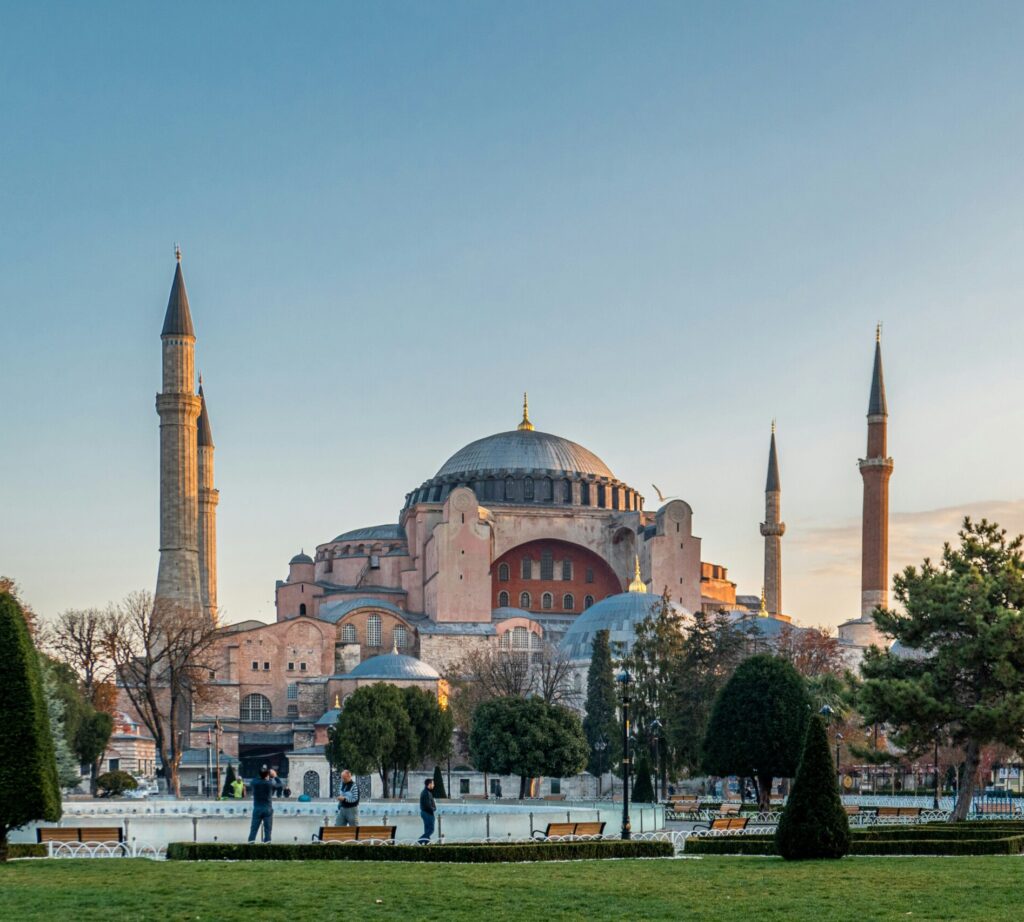
Turkey is a large peninsula that bridges the continents of Europe and Asia. Turkey is surrounded on three sides
by the Black Sea, the Mediterranean Sea, and the Aegean Sea. Istanbul, the largest city in Turkey, is built
on land in the Bosporus seaway. The city is partly in Europe and partly in Asia.
POPULATION
86 million inhabitants
CURRENCY
Turkish Lira (TRY)
GDP
$ 1.57 trillion
MINIMUM MONTHLY WAGE:
TRY 33,030.00 gross
TIME ZONE
UTC +3
The Turkish people are from diverse backgrounds, a reminder of the many different groups that conquered Turkey over thousands of years.
The majority of the population lives in cities, and children who want to go to high school must move to a city. The people are primarily Sunni Muslims. 1/5 of the population is Kurdish.
Employment contracts
The Labour Code defines an employment contract as a written contract between employer and employee. It may be open-ended or fixed-term. Fixed-term employment contracts may only be concluded where there is an objective reason justifying a fixed term. Fixed-term contracts can total up to 24 months (with or without interruption). Otherwise, the contract is deemed open-ended.
In cases where parties prescribe a trial period, the duration cannot exceed 2 months.
On-Call employment
Workers may be hired for irregular, intermittent needs (e.g. special events, peak periods). On-call employees have standard employment protections and are paid only for hours worked.
- Normal weekly working hours may not exceed 45 hours.
- Employees shall be entitled to the following types of leave:
• Vacation, consisting of a base and additional vacation time. Employees who have completed a minimum of 1 year of service in
the establishment since their recruitment, including the trial period, areentitled to take paid annual leave.
Length of employment Number of days of paid leave per year*
between 1 and 5 years (incl.) – 14 days
more than 5 and up to 15 years – 20 days
15 years and more – 26 days
*For employees under the age of 18 and above the age of 50, the length of paid annual leave must not be less than 20 days.
The length of annual leave with pay may be increased by employment contracts and collective agreements.
Unpaid leave
Upon request, 6 months of unpaid leave will be granted for the female employee after the expiration of statutory maternity leave and for married couples who adopted a child under 3 years old.
Sick leave
Duration depends on medical reports and social security rules. Sick leave payments are partially covered by SGK from the 3rd day at 66.7%. Employer practice may vary (they often cover the first 2-7 days in full).
Bereavement leave
Employees are entitled to 3 days of paid leave in the event of the death of the employee’s mother, father, spouse, brother or sister, and child.
Military leave
Employees are entitled to up to 90 days of paid leave per calendar year when having been called up for military exercises or for the performance of a statutory obligation, other than compulsory military service
Overtime is permitted but must be paid at 50% above the normal hourly rate.
Turkey has 15.5 public holidays (for 2026). Public holidays are regulated by Turkish law. National holidays are fixed by date, while Islamic religious holidays vary annually according to the lunar calendar.
January 1 Day New Year’s Day
March 19 (in 2026) Half a day (afternoon) Eve of Eid al-Fitr (Ramazan Bayramı Eve)
March 20-22 (in 2026) 3 Days Eid al-Fitr (Ramazan Bayramı)
April 23 1 Day National Sovereignty and Children’s Day
May 1 Day Labour and Solidarity Day
May 19 Day Commemoration of Atatürk, Youth and Sports Day
May 26 (in 2026) Half a day (afternoon) Eve of Eid al-Adha (Kurban Bayramı Eve)
May 27-30 (in 2026) 4 Days Eid al-Adha (Kurban Bayramı)
July 15 Day Democracy and National Unity Day
August 30 1 Day Victory Day
October 28 Half a day (afternoon) Republic Day Eve
October 29 Day Republic Day
- Health insurance.
- Meal allowances.
- Transportation allowances.
- Bonus plans.
- Professional development opportunities.
Termination at the Initiative of the Employee
- An employee may terminate an employment contract by giving written notice in accordance
with the statutory notice periods based on length of service.
Notice periods are determined by Labor Law – minimum notice periods are set on the basis of length of employment:
Length of employment (tenure) – Notice period (weeks) – Notice period (days)
Less than 6 months 2 weeks – 14 days
Between 6 months and 18 months 4 weeks – 28 days
Between 18 months and 36 months 6 weeks – 42 days
More than 3 years 8 weeks – 56 days
Termination at the Initiative of the Employer
An employer can terminate an employment contract for just cause or without just cause.
- without cause: The employer may terminate with notice, using the regular notice period
rules. In lieu of notice, the employer may compensate the employee for the notice
period (notice pay). - with cause: An employer can dismiss an employee without notice or severance only for
just cause (e.g. serious misconduct or breach of contract, violation of company rules). In
such cases, an immediate termination is permitted but must be well documented as the
employee may challenge termination before the labour courts where applicable.
Termination at the mutual consent
- Both Employer and employee can agree to terminate the contract at any time by mutual
consent. The settlement details (e.g. compensation) should be documented in writing.
Immediate Termination
- An employment contract can be terminated immediately in cases of gross misconduct,
violation of company rules, or in case of a serious breach of the employment contract. Immediate termination must comply with Article 25 of the Turkish Labour Law.
Upon termination (with notice), the employer must provide written notice stating the reason and termination date.
On the last day, the employer must pay all due sums: pro-rated salary, payment for unused vacation days, severance pay (if any), and any other statutory benefits. A formal termination letter or certificate is issued to the employee.
The length of annual leave with pay may be increased by employment contracts and collective agreements.
Social leave for pregnancy, maternal/paternal, and childcare leave
Female employees are entitled to up to 24 weeks of paid maternity leave (12 weeks before childbirth and 12 weeks after). In cases of multiple pregnancies, the pre-birth maternity leave period is extended by extra 2 weeks, subject to medical certification.
Employees are allowed to work up to 3 weeks before the delivery – the unused leave period will be added to the leave granted after the delivery.
Part of maternity and sick leave payments is compensated by the Social Security Institution (SGK) in accordance with applicable regulations.
Parental Leave
If both parents are employed, one parent may request part-time work until the child starts primary school, subject to statutory conditions and prior written notice.
Fathers (and adoptive parents) are entitled to 15 days of paid leave following the birth of a child.
Severance pay equals to 30 days’ gross salary for each full year of service (pro-rated for partial years), subject to the statutory severance cap. The upper limit for severance pay for the period from Jan 1, 2026 to June 30, 2026, has been set at 64,948.77 TL.
The severance cap is updated semi-annually by the Ministry of Treasury and Finance.
Severance is payable only where statutory conditions/ eligibility criteria are met.
Foreign nationals seeking to work in Turkey, typically need the following:
- Work Permit (WP)
Foreign nationals must obtain a work permit from the Ministry of Labor and Social Security in order to
worklegally in Turkey. This permit is usually valid for 1 year and can be renewed. - Residence Permit (RP)
Foreign nationals must obtain a residence permit, which is issued by the local migration office. The
residence permit is usually valid for 1 year and can be renewed. Foreign nationals may become eligible
for a long-term residence permit after 8 years of uninterrupted legal residence in Turkey, subject to
conditions.
Tax number: Foreign nationals must also obtain a tax number from the local tax office to pay taxes in Turkey.
Social security number: Foreign nationals must register with the Social Security
Institution (SGK) to receive health coverage and social benefits.
Foreigner identity number (YKN) / residence card: Foreigners who will stay in Turkey for more than 6 months, should apply for a card.
The permits are generally issued within 4-6 weeks. It is advisable to start the permit process well before
the intended start date, as gathering documents and waiting for approvals can take time.
• It’s important to note that the employer is responsible for obtaining the work permit on behalf of the foreign national employee, and the employee will need to provide certain
documents and information to the employer for this process.
• WP and RP can be renewed for additional one-year periods, if the foreign national continues to work for the same employer and meets the other requirements for the permits.
• Work and residence permits can be renewed indefinitely (the former five-year limit has been removed).
• Tax number and social security number are valid for life and residence card / foreigner ID card (YKN-based) is valid for 5 years and it can be renewed.
• It is important to note that the foreign national should apply for the renewal of the work permit and residence permit before the expiration date to avoid any interruption in the legal status and also to avoid any penalties or fines.
• There is a fee for a work permit extension.
• The employer is also responsible for canceling the employee’s work permit if the employee is a foreigner and notifying the relevant authorities.
Please note that all immigration requests should be reviewed on case-by-case basis.
If you need
more
information
Our team of dedicated managers will gladly support you with any specific information you might need
WHY YBS?
What truly sets YBS apart is our unwavering dedication to understanding our clients’ unique requirements. We believe in a personalized approach, taking the time to listen to our clients’ needs, goals, and challenges. By doing so, we can tailor our services to suit their specific circumstances, providing tailored solutions that address their pain points and drive positive results
Cost
effective
Maximizing Value, Minimizing Expenses
Time
efficient
Optimizing Results, Minimizing Waiting Time
100%
compliant
Guaranteed Compliance, Zero Compromises.
Tailored to your Needs
Customized Solutions, Unique You