
- Home
- -
- Countries_old
- -
- Tajikistan
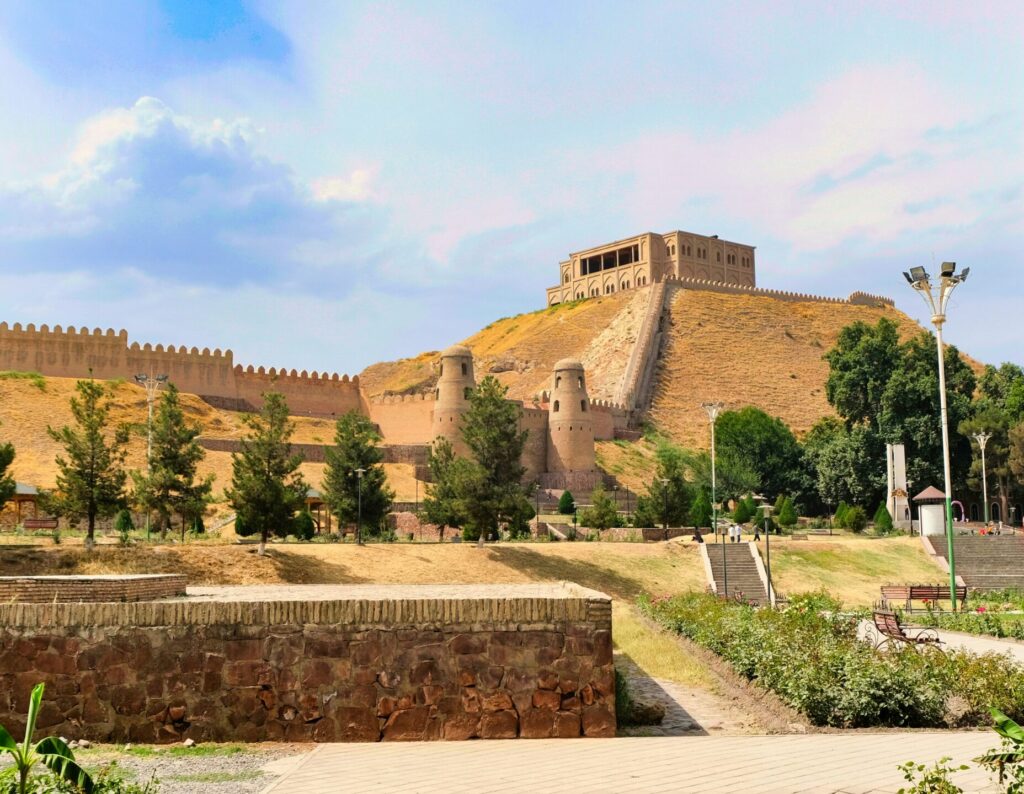
Tajikistan
Tajikistan is a landlocked country in Central Asia, bordering Uzbekistan, Kyrgyzstan, Afghanistan, and
China. The country has a population of 10.4 million people. The capital and largest city is Dushanbe,
with around 1 million inhabitants. The official language is Tajik, but Russian is also widely spoken.
POPULATION
10,98 million inhabitants
CURRENCY
Tajikistani Som (TJS)
GDP
$ 17,03 trillion
MINIMUM MONTHLY WAGE:
TJS 1,000
(increased to TJS 1,300 starting September 1, 2026).
TIME ZONE
UTC +5
Tajikistan has a growing lower-middle-income economy, supported largely by remittances, mining, and services. Many citizens work abroad, and remittances remain a major source of income, accounting for a significant share of GDP.
The country is rich in gold and other minerals, making mining one of its key industries. Digital services and tourism are gradually expanding.
Agriculture also plays an important role, although it remains vulnerable to climate and weather-related challenges.
Tajikistan continues to invest in renewable energy, particularly hydropower, with ambitions to rely predominantly on green electricity in the coming years. The government is also working to improve infrastructure, including roads, public transport, and internet connectivity.
Employment contracts:
- Indefinite contract – Regular job with no end date. It can only be ended with proper notice and reason.
- Fixed-term contract – For temporary work or projects, up to 5 years.
- Seasonal contract – For seasonal jobs, up to 6 months.
- Short-term contract – For very short jobs, up to 2 months.
Service contracts (freelance work):
Used for independent or freelance jobs.
Governed by civil law, not labor law.
No guaranteed benefits like paid leave or insurance unless agreed in the contract.
- Standard workweek: 40 hours
- Night work: Reduced by 1 hour per shift if half the work is at night.
- Breaks: Minimum 30 minutes, up to 2 hours (not counted as working time).
- Daily rest: At least twice the length of the work shift, including the break.
- Weekly rest: At least 42 consecutive hours.
Overtime work is permitted in exceptional cases:
Weekday overtime: At least 150% of the regular wage for the first 2 hours.
Additional hours: Paid at 200% of the regular wage.
Weekend/Public holiday work: 200% or with extra rest time.
- Sick leave compensation: Paid by the state social insurance fund. Amount depends on length of service and reason for leave.
- Maternity leave: 140 days total (70 days before and 70 days after childbirth). Extended in complicated or multiple births.
- Health insurance: Provided by the state system, with optional private insurance available.
- Pension system: Employer contribution 25%, Employee contribution 1%.
- Work injury insurance: Compensation provided through the state social insurance system in case of workplace accidents.
- Private health insurance: Some employers offer private plans that cover extra medical costs, specialist visits, and hospital stays.
- Life and accident insurance: Group insurance is provided by some companies, covering accidents and death.
- Pension top-ups: Employees can make voluntary contributions to private pension funds to increase future retirement income.
Food allowances.
Transportation allowances.
Education support and training allowances.
- Minimum paid leave: 24 calendar days per year.
- Additional leave granted to: Employees in hazardous jobs, Disabled employees.
- Unused leave: Must be used within the next year or compensated upon
termination.
Public holidays: Employees receive paid days off.
Public Holidays
January 1 — New Year’s Day
March 8 — International Women’s Day
March 21–24 — Navruz (Spring Festival)
March 20 (expected) — Eid al-Fitr (date may vary by 1 day)
May 1 — Labour Day
May 9 — Victory Day
May 27 (expected) — Eid al-Adha (date may vary by 1 day)
June 27 — Day of National Unity
September 9 — Independence Day
November 6 — Constitution Day
Note:
- Employees working on public holidays receive double pay or an extra day off.
- Employers must shorten the workday by at least one hour before a public holiday.
- Maternity leave: 140 calendar days total (70 before birth, 70 after); fully paid by the state social insurance fund.
- Parental leave: Either parent can take unpaid leave until the child turns three.
- Additional support: Mothers may receive a childcare allowance during unpaid leave. Fathers may take unpaid
parental leave, but there is no statutory paid paternity leave under current labor laws.
Foreign nationals must obtain a work permit and appropriate visa to be employed in Tajikistan. The main visa types include:
- Work visa (M) – For employment under a labor contract; valid up to 3 months, extendable to 1 year
- Business visa (K) – For short-term business activities; requires an invitation letter
- Investor visa (I) – For individuals investing in Tajikistan; valid up to 3 years
- Temporary residence permit – Available for foreign workers and investors
- Permanent residence permit – Issued after five years of temporary residence
Applications are processed by the Ministry of Foreign Affairs and the Migratory Service of the Ministry of Labor
Employment can be terminated under the following conditions:
- By mutual consent – Requires a written agreement.
- Expiration of fixed-term contract – Automatically ends unless renewed.
- Employee resignation – Requires 14 days’ notice.
- Employer-initiated dismissal – Requires valid legal reasons (e.g., redundancy, misconduct, poor performance, health-related inability to work).
- Immediate termination – Allowed in cases of gross misconduct (e.g. theft, workplace violence, serious rule violations).
Notice period:
- Employer-initiated dismissal: 1 month for reasons like poor performance or health issues; 2 months for staff reduction or company closure
- Immediate termination: Allowed in cases of gross misconduct, such as theft or serious violations.
The eligibility for and amount of severance pay depend on various factors, including the reason for termination.
- Redundancy or company liquidation: Employee receives one month’s average salary; Plus up to two additional months of salary during job search;
A third month may be paid if registered with employment services - Dismissal for misconduct or poor performance: No statutory severance pay, unless stated in the employment or collective agreement.
- Severance may be provided based on contract terms or company policy
If you need
more
information
Our team of dedicated managers will gladly support you with any specific information you might need
WHY YBS?
What truly sets YBS apart is our unwavering dedication to understanding our clients’ unique requirements. We believe in a personalized approach, taking the time to listen to our clients’ needs, goals, and challenges. By doing so, we can tailor our services to suit their specific circumstances, providing tailored solutions that address their pain points and drive positive results
Cost
effective
Maximizing Value, Minimizing Expenses
Time
efficient
Optimizing Results, Minimizing Waiting Time
100%
compliant
Guaranteed Compliance, Zero Compromises.
Tailored to your Needs
Customized Solutions, Unique You