
- Home
- -
- Countries_old
- -
- Switzerland
Switzerland
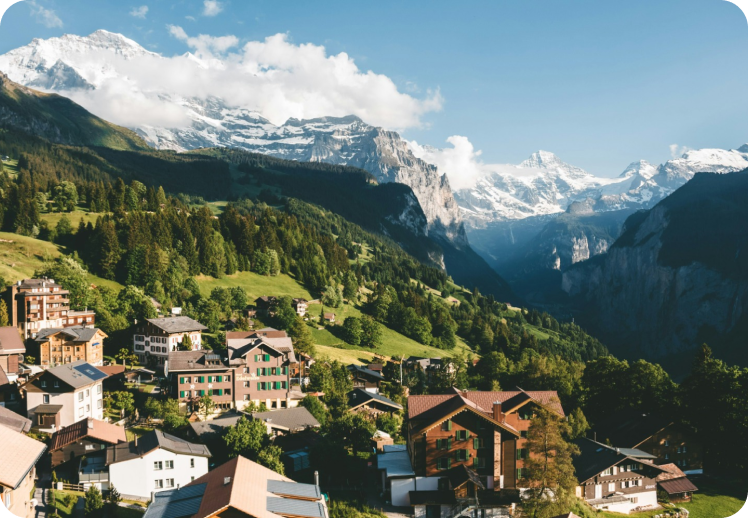
Switzerland is a federated country in central Europe. Switzerland’s administrative capital is Bern, while Lausanne serves as its judicial center. Five countries share borders with Switzerland: France, Germany, Austria, Liechtenstein and Italy.
POPULATION
8.9–9.0 million inhabitants
CURRENCY
Swiss franc (CHF)
GDP
$820 billion
MINIMUM MONTHLY WAGE:
No national minimum wage
TIME ZONE
UTC +1
Switzerland’s cities have emerged as international centers of industry and commerce connected to the larger world. As a consequence of its remarkably long-lived stability and carefully guarded neutrality, Switzerland – Geneva, in particular has been selected as headquarters for a wide array of governmental and nongovernmental organizations, including many associated with the United Nations.
- Individual employment contract
- Permanent, Fixed-term contract
- Full-time, Part-time contract
- Temporary contract
- Collective bargaining agreement (CLA) – concluded between employers’ associations and employees’ associations.
- Standard Contract of Employment (CTT) – which follows the guidelines of the central government or the cantons that regulate
labor contracts, especially in agriculture and personal services.
Trial period
The trial period is, by statutory law, considered to be the first month of an employment relationship. However, if agreed in writing, the trial period may be extended to three months.
The statutory maximum working time is generally 45 hours per week for industrial, office, retail and technical employees, and 50 hours for other sectors.
Working hours in Switzerland may vary depending on the employer, position, and the industry in which one works. The average amount worked by an industrial worker is around 40 hours a week, with service and creative sectors working for around 42 hours a week.
The length of the break depends on the number of working hours per day:
- 15 minutes for 5 1/2 work hours a day
- 30 minutes for more than 7 work hours a day
- 1 hour for more than 9 hours a day; in this case more than one break can be taken
When the amount of work that employee do in a week exceeds the official maximum for working hours in Switzerland
(45 hours a week) or the working hours defined in the contract.
If not agreed otherwise by the parties, the employer must compensate overtime by a 25% wage increment. Alternatively, and under the condition of a mutual agreement between the parties, overtime can be compensated by a vacation time, granted at an appropriate moment.
Regardless of whether employee works full or part-time, he/she is entitled to at least four weeks’ vacation per year.
The first of August – Swiss national day – is Switzerland’s only national public holiday.
However, the 26 cantons that make up Switzerland can have additional public holidays on their territory.
Public holidays can thus vary from canton to canton.
1 January — New Year’s Day
2 January — Berchtold’s Day (не во всех кантонах)
3 April — Good Friday (не во всех кантонах)
5 April — Easter Sunday
6 April — Easter Monday
14 May — Ascension Day
24 May — Whit Sunday (Pentecost)
25 May — Whit Monday
1 August — Swiss National Day (единственный федеральный праздник)
25 December — Christmas Day
26 December — St. Stephen’s Day
Swiss federal law provides 14 weeks (98 days) of paid maternity leave. Women are generally entitled to 80% of their average earned income before childbirth, up to a maximum of CHF 220 per day.
Fathers are entitled to two weeks (10 working days) of paid paternity leave within the first six months after birth.
Swiss labor law also allows for 16 weeks of maternity leave after the birth, during which time a woman cannot be dismissed by her employer.
Women who take maternity leave in Switzerland are generally entitled to 80 percent of the average earned income they received before giving birth. However, the maximum amount to which they are entitled is set at CHF 220 per day, or CHF 6,600 per month. This means that women in well-paid positions will receive a significantly lower income during maternity leave compared to their regular job.
The child’s father is also entitled to at least two weeks of paternity leave in the first six months after the birth of the child.
He can take these two weeks in one go or spread them over different days.
The father is entitled to 80 percent of his average salary up to a maximum of CHF 220 per day.
Generally, employee needs to obtain a medical certificate after three days off work.
If employee is off work because off illness, the salary will continue to be paid in one of two ways:
- The employer has sickness benefit insurance for employees. Most employers are insured. The employee will continue to receive salary for 720 or 730 days of illness over 900 days, depending on the type of insurance.
- The employer does not have sickness benefit insurance for employees. In this case, the employer must continue to pay salary for a certain period: this amounts to three weeks in the first year of employment and increases every additional year to a maximum of four months. The exact period that the salary is paid varies from region to region.
The key state and compulsory benefits offered by employers in Switzerland are retirement benefits, death in service, long-term disability benefits, short-term sickness benefits, medical benefits, workers’ compensation insurance, maternity and paternity benefits, and other benefits.
- Retirement Benefits the Switzerland pension system comprises the following three pillars. The first pillar consists of a pension system (DB system) offering old-age and survivors’ insurance. The second pillar consists of the occupational pension system, which includes both DB and DC plans. The third pillar includes individual voluntary pensions.
- Short-Term Sickness Benefits – a short-term sickness benefit is an optional insurance scheme that covers the risk of wage loss due to sickness. It also covers the risk of wage loss due to an accident if it is not covered by accident insurance. These benefits are funded through the contributions made by the employer and employee. In case of sickness, there is a continued payment of wages by the employer for a limited period.
- Medical Benefits – all persons residing in Switzerland are required to be mandatorily insured for healthcare. The persons should become insured within three months from the day they start residing in the country. It is not the responsibility of employers to insure employees for healthcare. The health insurance ceases after the insured dies or if the insured moves out of the EU/EFTA for residence.
The key private benefits offered by the employers of Switzerland are retirement benefits, death benefits, medical benefits, disability benefits, accidental death and dismemberment benefits, and other benefits.
- Retirement Benefits -in Switzerland, employers’ participation in voluntary retirement benefits is generally limited to contributions made for those employees who are not covered by the mandatory provisions of Pillar II occupational pension schemes. Most employers provide pension benefits to employees through voluntary contributions to occupational pension plans under Pillar II. Employer-sponsored voluntary defined benefit retirement plans are not prevalent. Pillar III is an individual voluntary pension system, which is only applicable to employees and self-employed persons who are not eligible for the Pillar II mandatory occupational pension system.
- Disability Benefits in Switzerland, employers provide long-term disability benefits to their employees through comprehensive group risk insurance plans, group accidents, and group health, which cover both death and disability due to sickness or accident, but standalone short-term disability plans are not prevalent in the country.
- 13th month salary is common in Switzerland, although not legally required – no statutory requirement, but it is customary for employers to pay.
- Communication benefits – employers may provide company mobile phones or notebooks to their employees.
- Training and Development.
- Meals – meal allowances in the form of lunch checks (between CHF 100 – CHF 180 per month), or in the form of cafeterias catering fully or partially subsidized lunch to employees are typical for large companies.
- Senior and Services Awards – companies typically provide modest discretionary seniority and services cash awards.
- Discounts on company products.
- Flexible work hours / Home Office – It is very common to offer flexible work hours, and working from a home office is getting more popular too.
- Supplementary vacation time or/and sabbaticals.
Switzerland is not part of the European Union (EU) but has a lot of its benefits due to participation in
the EFTA (European Free Trade Association).
EU/EFTA citizens do not need a visa for entering Switzerland, but they to register and apply for a Swiss residence permit
if they want to live there long-term (more than three months.)
Switzerland is also part of the Schengen area. Citizens of Schengen countries can also move to Switzerland without a visa,
but have to apply for a residence permit for stays exceeding three months.
Switzerland has imposed strict annual limitations in regard to how many residences and work permits it grants to non-EU/EFTA
citizens.
General framework for visas:
- Schengen Visa, type C – for entry and a stay of up to 90 days within a period of 180 days, for example in the context of tourism, a visit, short-term language studies, etc.
For a stay involving gainful employment a work permit is also required. - National visa, also known as type D – for longer term stays in Switzerland (more than 90 days). This visa is issued subject to authorisation from the cantonal migration authority competent for the intended place of residence in Switzerland.
Any employment contract concluded for an indefinite period may be unilaterally terminated by both employer and employee,
subject to statutory notice periods.
The following notice periods apply:
- during the probation period: 7 calendar days.
- during the first year of employment: 1 month, from the last day of the month (e.g. if employment is terminated on 13 June
and the notice period is 1 month, contract will end on 31 July). - from the second to the ninth year of employment: 2 months, from the last day of the month.
- from the tenth year of employment onwards: 3 months, from the last day of the month.
Both employers and employees have a right to terminate the employment contract immediately and without notice for cause,
regardless of whether the contract was concluded for an indefinite period and regardless of any statutory notice periods, which
would apply to an ordinary termination.
A fixed-term contract automatically ends on the agreed date and generally cannot be terminated in advance except in serious cases
or if the contract provides for this possibility. Employer and employee can end a fixed-term contract early, however, as long as this is
done by mutual agreement and in accordance with the law.
There are no statutory severance payment obligations. An obligation may, however, be provided by a collective agreement or by a social plan in case of collective redundancy.
An “indemnité à raison de longs rapports de travail” is paid to workers over age 50 and more than 20 years seniority and cannot be less than 2 months wages, with a maximum amount of 8 months wages.
If you need
more
information
Our team of dedicated managers will gladly support you with any specific information you might need
WHY YBS?
What truly sets YBS apart is our unwavering dedication to understanding our clients’ unique requirements. We believe in a personalized approach, taking the time to listen to our clients’ needs, goals, and challenges. By doing so, we can tailor our services to suit their specific circumstances, providing tailored solutions that address their pain points and drive positive results
Cost
effective
Maximizing Value, Minimizing Expenses
Time
efficient
Optimizing Results, Minimizing Waiting Time
100%
compliant
Guaranteed Compliance, Zero Compromises.
Tailored to your Needs
Customized Solutions, Unique You