
- Home
- -
- Countries_old
- -
- Romania
Romania
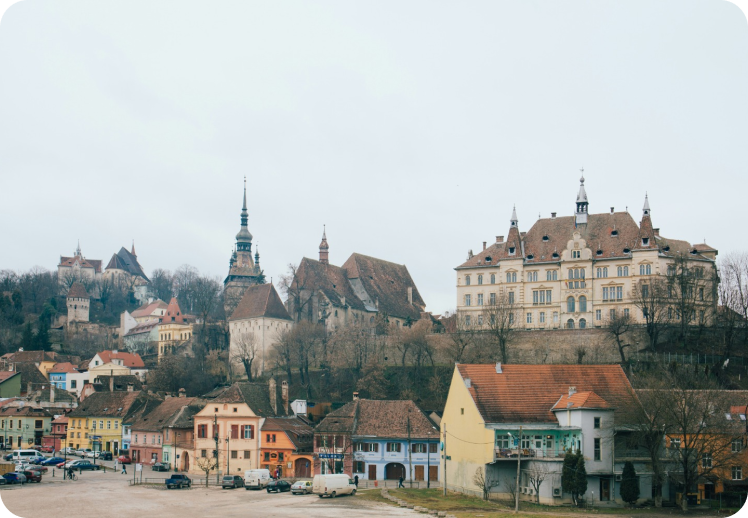
Romania is located at the crossroads of Central, Eastern, and South-eastern Europe. It borders the Black Sea, Bulgaria, Ukraine, Hungary, Serbia, and Moldova.
POPULATION
18,9 million inhabitants
CURRENCY
Romanian Leu (RON)
GDP
$422,51billion
MINIMUM MONTHLY WAGE:
4 050 RON util June 30’26
4 325 RON effective July 1’26
TIME ZONE
UTC +2
Romania in 2025 is making steady progress in several key areas. Economic growth remains strong, driven by foreign investments, digitalization, and EU-funded projects. The country is becoming a regional hub for IT and technology, with cities like Cluj-Napoca, Bucharest, and Iași attracting global tech companies and startups.
Infrastructure is improving, with new highways, modernized railways, and better urban transport systems being developed. The renewable energy sector is expanding, with Romania investing in wind, solar, and hydro projects, reducing reliance on fossil fuels.
Tourism is also growing, with Transylvania, the Carpathians, and the Black Sea coast attracting
more visitors. The country’s rich cultural heritage, combined with improved services and
infrastructure, makes Romania an increasingly popular destination.
Despite demographic challenges, wages are rising, and the quality of life is gradually improving. Digital transformation in government services and businesses is making daily life easier, contributing to a more modern and connected society.
Permanent Employment Contracts. Open-ended and indefinite contract can be terminated by either party in accordance with statutory procedures.
Fixed-term Employment Contracts. At the moment, the Labor Code no longer limits, through an explicit provision, the number of extensions that can be made within the maximum term of 36 months. The contract can be extended as many times as necessary within this 36-month limit.
Part-time Employment Contracts. These can be either open-ended or fixed term.
Collective Bargaining Agreements: Collective agreements can be concluded through negotiations between employers, employees and their representatives or trade union
Probation Periods: These can be included in a contract, only once per employment. They are generally for 90 days, although can be shorter if applied to fixed-term contracts or temporary employees. Probation periods for executives and managers can be extended to 120 days.
• The normal duration of working time is 40 hours per week and 48 hours per week (including overtime).
• By way of exception, the length of the working time, including the overtime, may be extended beyond 48 hours per week, provided that the average working hours, calculated over a reference period of three calendar months, do not exceed 48 hours per week.
• Reference periods of up to 12 months can be agreed under collective labour agreements. These maximum limits cannot be derogated from on an individual basis.
• Normal working time of up to 12 hours per day can be set out for certain activities either by individual or collective negotiation, if it is followed by a mandatory daily rest time of 24 hours.
• The Romanian Labour Code entitles employees to a minimum 20 working days annual holiday leave. Provided the employee has worked for at least one month during the preceding 12 months, pregnant employees are entitled to 126 days of maternity leave, usually 63 days before birth and 63 after the birth, with an allowance equal to 85% of their average salary during the previous six months.
There are no fringe benefits prescribed by Romanian Labour Code, however general practice is to provide the employees with:
• meal vouchers
• medical insurance to private clinics
• allowances: car, telephone, work from home allowance and etc.
Strict procedural rules and timelines must be observed by the employer when dismissing an employee, depending on the type of dismissal:
1. By employer’s will.
Employer may terminate the contract only with the valid reason, specified in the local law.
Notice period is 20 working days. Dismissal for disciplinary reasons:
- Disciplinary investigation. This investigation must be conducted within a six-month period from the date the misconduct is committed.
- Dismissal for poor performance. Can only take place after the employer has verified the employee’s professional competence, and subject to the employer not being able to offer another suitable job to the employee.
- Dismissal for economic reasons. Needs to be backed up by a strong economic justification of the measure, and so on. In certain cases, the authorities or third parties may be involved (for example, where there is an economic dismissal, or collective dismissals, or a dismissal for medical inaptitude).
2. Mutual agreement.
This is the best and recommended approach to handle terminations. Employee and
employer can agree on the date of the termination and amount of the severance
payment.
3. By employee’s will.
Employee has a right to terminate his/her contract at any time. Usually, the notice
period for termination upon the initiative of the employee is a maximum of 15 calendar
days (30 calendar days for employees in executive positions)
• 01 – Jan New Year’s Day
• 02 – Jan New Year Holiday
• 06 – Jan Epiphany
• 07 – Jan Synaxis of St. John the Baptist
• 24 – Jan Union of the Romanian Principalities
• Orthodox Good Friday (varies each year)
• Orthodox Easter Day (varies each year)
• Orthodox Easter Monday (varies each year)
• 01 – May Labor Day
• 01 – Jun Children’s Day
• Orthodox Whit Sunday (varies each year)
• Orthodox Whit Monday (varies each year)
• 15 – Aug Assumption Day
• 30 – Nov Feast of Saint Andrew
• 01 – Dec Great Union Day
• 25 – Dec Christmas Day
• 26 – Dec 2nd Day of Christma
Foreign national working in Romania will need the following approvals:
• EU/South East Europe (SEE) and Swiss nationals can enter and reside in Romania for
up to three months, and no visas, permits or registration are required. If the stay is extended beyond three months, they must obtain a registration certificate.
• Non-EU/SEE or non-Swiss nationals can work in Romania under a work permit (issued
by the Romanian Immigration Office) and a long stay visa (issued by diplomatic missions or consular offices).
EU/South East Europe (SEE) and Swiss nationals:
- Obtaining a work contract with local employer.
- Obtaining the work authorization.
After obtaining a work contract, employer must request the work authorization for
candidate from the Romanian authorities.
- Submitting the work permit application.
o After the work authorization is issued, candidate must submit a work permit application to the competent Romanian authorities, along with other documents
such as candidate`s passport and criminal record certificat. - Waiting for the decision.
The Romanian authorities will make a decision within 30 working days from the
submission of the application.
- Obtaining the work permit.
If application is approved, candidate will receive the work permit, which will be
valid for the period specified in the employment contract
Non-EU/SEE or non-Swiss nationals
Employment notification
In this case, the employer must obtain an employment notification. Depending on the type of activity that the employee performs, there are multiple categories in which he/she may be classified: permanent workers, probationary, seasonal etc. After obtaining the work permit, the employer must forward this document to the employee, and he/she will obtain a long-term visa for employment from the proper diplomatic missions and the consular offices of Romania.
Visa
Procedure for obtaining approval. The long stay visa can be obtained by the foreign national by submitting their work permit to the Romanian Immigration Office, along with other documents, among which the criminal record and medical insurance during the validity of the visa.
The foreign national must apply for a long stay visa within 60 days from obtaining the work permit. The long stay visa is granted for 90 days and can be extended for the entire duration of the employment contract plus a period of up to two years depending on the circumstances (where it is extended, the long stay visa is replaced with a stay permit).
Staying in Romania after the expiry a long stay visa (or stay permit) is an administrative offence and can trigger a fine.
Single permit.
After entering Romania, a single permit must be obtained. The required documents are filed personally by the applicant (a picture will be taken) at the local branch of the General Immigration Inspectorate with at least 30 days prior to the expiration of the visa.
After entering Romania, a single permit must be obtained. The required documents are filed personally by the applicant at the local branch of the General Immigration Inspectorate with at least 30 days prior to the expiration of the visa.
For the first extension of the right of stay (obtaining the first single permit) for employment the following documents must be filed:
▪ Application
▪ Transit document (passport, travel title) in both original and copy
▪ Proof of legal possession of living space in both original and copy
▪ Work contract
▪ Salary
▪ Medical certificate
▪ Other taxes The single permit is renewed with at least 30 days prior to the old one’s expiration.
The General Immigration Inspectorate solves the request for releasing the employment notice in a maximum term of 30 days from the requests’ registration. In the cases where extra checks are required the term can be extended with a maximum of 15 days
Strict procedural rules and timelines must be observed by the employer when dismissing an employee, depending on the type of dismissal:
1. By employer’s will.
Employer may terminate the contract only with the valid reason, specified in the local law. Notice period is 20 working days. Dismissal for disciplinary reasons:
Disciplinary investigation. This investigation must be conducted within a six-month period from the date the misconduct is committed.
Dismissal for poor performance. Can only take place after the employer has verified the employee’s professional competence, and subject to the employer not being able to offer another suitable job to the employee.
Dismissal for economic reasons. Needs to be backed up by a strong economic
justification of the measure, and so on.
In certain cases, the authorities or third parties may be involved (for example, where there is an economic dismissal, or collective dismissals, or a dismissal for medical inaptitude).
2. Mutual agreement.
This is the best and recommended approach to handle terminations. Employee and employer can agree on the date of the termination and amount of the severance payment.
3. Byemployee’swill.
Employee has a right to terminate his/her contract at any time. Usually, the notice period for termination upon the initiative of the employee is a maximum of 15 calendar days (30 calendar days for employees in executive positions).
Romanian employment law makes no provision for severance payments for employees working in the private sector (except for the minimum notice period that applies). Severance payments are
generally provided for in the applicable collective labour agreements or in employment contract.
If you need
more
information
Our team of dedicated managers will gladly support you with any specific information you might need
WHY YBS?
What truly sets YBS apart is our unwavering dedication to understanding our clients’ unique requirements. We believe in a personalized approach, taking the time to listen to our clients’ needs, goals, and challenges. By doing so, we can tailor our services to suit their specific circumstances, providing tailored solutions that address their pain points and drive positive results
Cost
effective
Maximizing Value, Minimizing Expenses
Time
efficient
Optimizing Results, Minimizing Waiting Time
100%
compliant
Guaranteed Compliance, Zero Compromises.
Tailored to your Needs
Customized Solutions, Unique You