
- Home
- -
- Countries_old
- -
- Norway
Norway
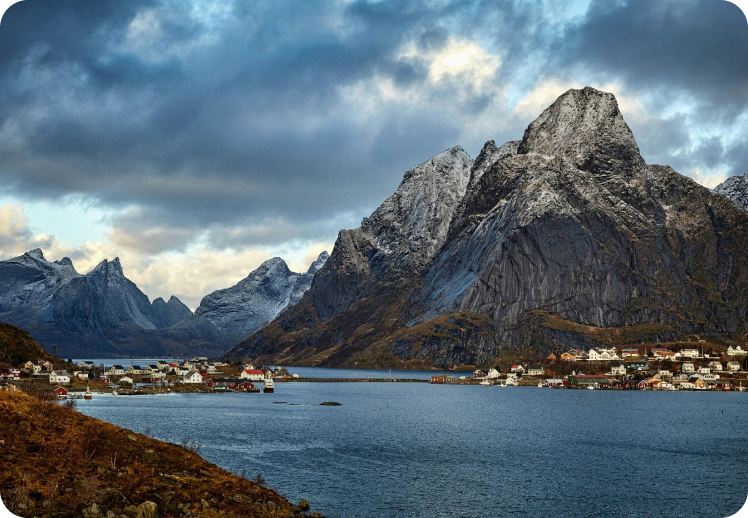
Norway is a Scandinavian country encompassing mountains, glaciers and deep coastal fjords. Oslo, the capital, is a city of green spaces and museums. Preserved 9th-century Viking ships are displayed at Oslo’s Viking Ship Museum. Bergen, with colorful wooden houses, is the starting point for cruises to the dramatic Sognefjord. Norway is also known for fishing, hiking and skiing, notably at Lillehammer’s Olympic resort.
POPULATION
5.572 million inhabitants
CURRENCY
Norwegian Kroner (NOK)
GDP
483,7 USD Billion
MINIMUM MONTHLY WAGE:
Does not have a minimum wage.
TIME ZONE
UTC +1
The economy of Norway is a highly developed mixed economy with state-ownership in strategic areas. Although sensitive to global business cycles, the economy of Norway has shown robust growth since the start of the industrial era. The country has a very high standard of living compared with other European countries, and a strongly integrated welfare system. Norway’s modern manufacturing and welfare system rely on a financial reserve produced by exploitation of natural resources, particularly North Sea oil.
- Fixed-term employment. This type of contract requires employers to meet the requirements of Norway’s
- Working Environment Act.
- Permanent employment contracts.
- Temporary employment.
According to Norwegian employment laws, all employees must have a written employment contract before the official start date or no later than 1 month after the official start date. Written employment contracts are required for all types of employee contracts.
The trial period may last for up to six months. Absences within this period can be added onto the overall probation period length.
- Working Hours
According to the Norwegian Labor Law, workers are subject to strict and detailed rules stipulated in the Working Environment Act. The working hours of employees are determined by the normal working hours, which are 9 hours a day and 40 hours per week (including breaks). This is the maximum limit for regular working time. In many sectors, especially under collective agreements, the actual standard is:
7.5 hours/day, 37.5 hours/week.
For workers who work in semi-continuous shift, nights or Sundays, it’s 38 hours per week. The normal working hours are
further reduced to 36 hours per week for continuous shift work and work in
underground mines, tunneling and blasting of rock chambers
- Annual Leave
Employers must provide their employees with 25 workdays of paid leave each year following the qualifying year.
- Sick leave
Employers typically cover the first 16 calendar days of sick leave. Unless otherwise specified in the employee’s contract or CBA, the Norwegian Labor and Welfare Service (NAV) pays from the 17th day forward. If an employee is absent due to illness, they must notify their employer. Sickness benefits are limited to 6 times the National Insurance basic amount per year unless otherwise agreed upon with the employer.
- Maternity/Paternity Leave
The parental benefit is a benefit payable to parents of newborn children, who have worked for at least six months and have paid contributions to the Social Insurance Fund. The benefit is paid for 1 year after the birth of the child, as long as both parents were insured at the same time and stay insured until the end of the benefit period.
Maternity benefit is calculated in the same manner as sickness benefit. The total period of maternity benefit may not exceed 49 weeks (15 weeks per parent), with full coverage or 59 weeks (19 weeks per parent), with 80% coverage.
The parental benefit period is the same as the maternity leave benefit period. The benefit is also paid for a 12 month period.
In addition to the first 12 months, each parent is entitled to 1 year of parental leave for each child born. This leave must be taken immediately following the first year. If a parent is caring for their child on their own, they are entitled to both years.
The parental benefit period begins on the day the child is born, or, if the child is born prematurely, on the date he or she has been in custody for at least two days following birth.
Companies in Norway are required to provide overtime pay for any hours worked in excess of 9 hours per day and 40 hours per week. Employees must be paid at a premium rate of at least 40% over the normal rate, or provided time off in lieu.
Work hours should not exceed more than 10 hours of overtime per week, 25 hours of overtime per every 4 weeks, and 200 hours of overtime per every 1 year.
1 January: New Year’s Day 25 May – Whit Monday
2 April – Maundy Thursday 25 December: Christmas Day
3 April – Good Friday 26 December: Boxing Day
5 April – Easter Sunday
6 April – Easter Monday
1 May – Labour Day
14 May – Ascension Day
17 May – Constitution Day
24 May – Whit Sunday
- Mandatory Benefits
- Probationary period
- Annual Leave
- Public Holidays
- Sick Leave
- Maternity Leave
- Paternity Leave
- Overtime Pay
- Notice period
- Social Security Benefits
Mandatory employee benefits in Norway (mandatory social security scheme) covers every employee and provides universal disability insurance, unemployment benefits, and health insurance for all citizens and residents.
- Fringe benefits
- The most common fringe benefits for employees are:
- Working from home (WFH)
- Life insurance
- Supplementary health insurance
- Free meals
- Flexible working hours
- Public transportation reimbursement
- Gym membership
- Additional days off
There is no mandatory requirement to pay the 13th or the 14th month salary. A commission plan or quarterly bonus plan is a common practice.
In Norway, non-EU/EEA nationals are required to obtain a work permit to engage in employment.
This includes individuals who have secured job offers from Norwegian employers and intend to reside and work in the country. EU/EEA citizens, however, do not need a work permit, but must register with Norwegian authorities if their stay exceeds three months.
The most common option for foreign professionals is the Skilled Worker Permit.
To qualify, the applicant must have a relevant job offer, higher education or vocational training, and the position must match their qualifications.
The minimum annual salary is NOK 473,000, or NOK 510,000 for jobs requiring a master’s degree.
For temporary employment, the Seasonal Worker Visa allows individuals to work in agriculture, forestry, fisheries, and similar sectors for up to 6 months. A concrete job offer is required, and the position must be in a field approved for seasonal work.
All applications must be submitted via UDI.no, and typically include the employment contract, education documents, passport, and a fee (around NOK 6,300). Processing time varies, but usually takes 1–3 months. Once approved, workers must register with the police and obtain a residence card upon arrival.
After three years of legal residence with a work permit, foreign nationals may qualify for permanent residency, provided they meet requirements for language skills, income, and clean criminal record.
The general income tax rate is 22 percent. The tax is calculated on general income. People on a low income pay proportionately less tax than those with a high income.
The Norwegian tax system distinguishes between full and limited tax liability for resident taxpayers and non-resident taxpayers. Residents are taxed on their worldwide income, whereas non-resident taxpayers are only taxed on certain types of income derived from Norwegian sources.
Employment, business, and capital income are all taxed at a flat rate of 22%.
Individuals, including non-residents receiving remuneration for services performed in Norway, are liable to social security and pension contributions, which are paid together with income taxes. Foreigners may be wholly or partly exempted from social security contributions, according to social security agreements, or upon application, provided they are satisfactorily covered in their home country. The European Economic Area (EEA) agreement may also exempt member-country citizens from Norwegian social security. The employer must also make social security contributions. The contribution is based on total Norwegian gross salary (and taxable benefit) costs.
In Norway, employment relationships are highly regulated to ensure fairness and job security. The termination process must
comply with the Working Environment Act (Arbeidsmiljøloven), which aims to protect employees from arbitrary or unjust dismissal.
Whether initiated by the employer or the employee, the process must follow clear legal procedures.
The minimum length of notice for both the employer and employee is one month.
However, most employment agreements in Norway typically specify a mutual notice period of three months.
For employees with a probation period in their contract, the minimum notice period is 14 days during the probation period.
Furthermore, a longer notice period may follow from statutory rules, based on age and seniority:
- Employees employed for at least five consecutive years – at least two months’ notice;
- Employees employed for at least ten consecutive years – at least three months’ notice;
- Employees employed for at least ten consecutive years and who are over 50 years of age – at least four months’ notice;
- Employees employed for at least ten consecutive years and who are over 55 years of age – at least five months’ notice
- Employees employed for at least ten consecutive years and who are over 60 years of age – at least six months’ notice.
There are no statutory provisions entitling employees to severance pay upon termination. These can be included in collective agreements. The employees are entitled to work in their notice period and receive pay as per usual.
However, the parties are free to enter into severance agreements. Employers tend to enter into such agreements as an
alternative to starting a termination process, or if an employee disputes a termination. Such agreements normally offer the employee either garden leave or economic compensation, or a combination of these elements. In return, the employee waives his/her legal right to dispute the termination
If you need
more
information
Our team of dedicated managers will gladly support you with any specific information you might need
WHY YBS?
What truly sets YBS apart is our unwavering dedication to understanding our clients’ unique requirements. We believe in a personalized approach, taking the time to listen to our clients’ needs, goals, and challenges. By doing so, we can tailor our services to suit their specific circumstances, providing tailored solutions that address their pain points and drive positive results
Cost
effective
Maximizing Value, Minimizing Expenses
Time
efficient
Optimizing Results, Minimizing Waiting Time
100%
compliant
Guaranteed Compliance, Zero Compromises.
Tailored to your Needs
Customized Solutions, Unique You